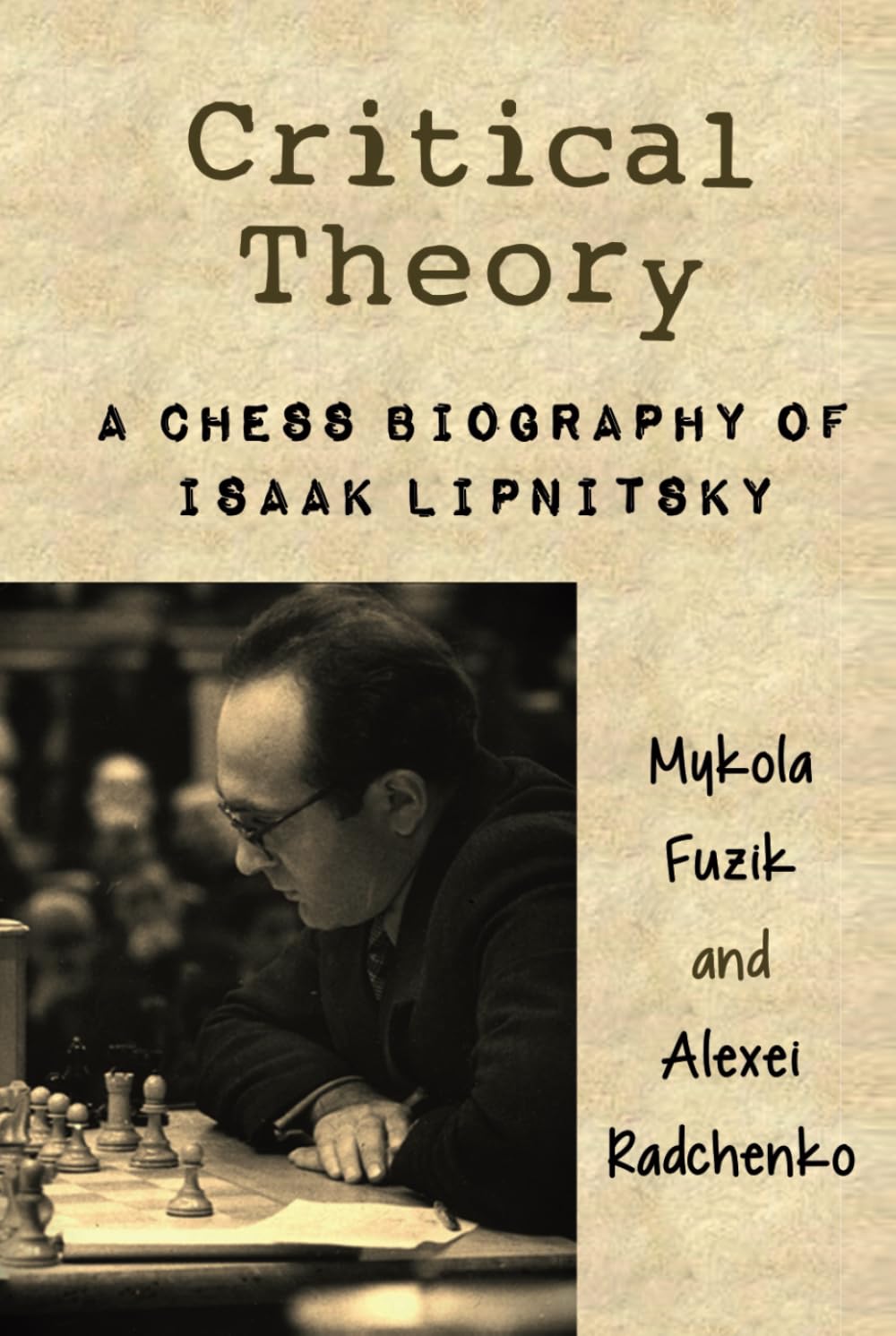
Critical Theory: A Chess Biography of Isaak Lipnitsky
Mykola Fuzik
Formato papel
[No disponible]
PVP. 28,60€
Ficha técnica
- Editorial: Elk and Ruby
- Fecha de edición: 1 de Enero de 1753
- ISBN: 9781916839014
- Fecha de edición: 1753
- Peso: 550gr
- Dimensiones:
150 mm x 230 mm
- Nº páginas: 264
- Materias: Libros / Divulgación y literatura /
Compartir en:


Tienda / Libros / Divulgación y literatura /
Critical Theory: A Chess Biography of Isaak Lipnitsky

Libro en inglés
Aquí tienes la traducción al castellano del texto: Isaak Lipnitsky (1923–1959) fue un destacado ajedrecista ucraniano de principios de la década de 1950, así como un célebre teórico y periodista, cuyo manual Cuestiones de la teoría moderna del ajedrez se convirtió en un clásico reconocido internacionalmente. Nacido en Kiev poco después del establecimiento del control soviético sobre Ucrania, logró el mejor resultado de su carrera al empatar en el segundo puesto en el Campeonato Soviético de 1950, a solo medio punto del ganador Paul Keres, torneo en el que derrotó a Petrosian, Smyslov y Geller. También disputó las finales de los Campeonatos Soviéticos de 1951 y 1952, y se coronó campeón de Ucrania en 1949 y 1956, además de ganar el Campeonato de Kiev en 1956. Según el sitio web Chessmetrics, Lipnitsky ocupó el puesto número 12 del mundo entre septiembre y diciembre de 1950, con un Elo máximo de 2700 y un rendimiento (TPR) de 2729 registrado en el Campeonato Soviético de 1950. En palabras del Gran Maestro Kevin Spraggett: “Como jugador, Lipnitsky estaba muy bien formado en estrategia y táctica, siendo capaz de jugar todo tipo de posiciones con igual destreza. Sin embargo, lo que realmente le gustaba era jugar posiciones complicadas, un rasgo que muchos de los mejores maestros ucranianos parecen haber heredado”. Biografía e Historia La fascinante biografía de Lipnitsky, con investigación original de los autores, nos traslada desde su infancia en una familia judía pobre hasta su ingreso en el club de ajedrez infantil del Palacio de los Pioneros de Kiev. Allí estuvo bajo la tutela del gran entrenador Alexander Konstantinopolsky, quien nutrió el talento de David Bronstein al mismo tiempo. La obra introduce al lector en los orígenes de la Escuela Soviética de Ajedrez en Kiev, que fue una de las mayores canteras de talento de la URSS. Se analiza también el servicio de Lipnitsky en la Segunda Guerra Mundial como oficial de inteligencia, lo que se conoce de su esposa e hija y su eventual carrera profesional en el ajedrez. Una Vida Trágica Lipnitsky falleció a la trágicamente temprana edad de 35 años a causa de una enfermedad terminal que mermó su rendimiento en los torneos durante sus últimos años. Sin embargo, su tragedia no se limitó a eso: sus abuelos paternos y sus tías fueron asesinados por los ocupantes nazis durante la guerra, y su hija murió años más tarde en un hospital psiquiátrico. Contenido del Libro Los Candidatos a Maestro e historiadores del ajedrez afincados en Kiev, Mykola Fuzik (nacido en 1957) y Alexei Radchenko (1947-2013), dedicaron varios años a investigar la biografía de Isaak Lipnitsky, publicada originalmente en Ucrania en 2018. Este libro ofrece: 63 de sus mejores partidas analizadas de forma instructiva, la mayoría anotadas por el propio Lipnitsky y sus contemporáneos, con correcciones mediante ordenador. Enfrentamientos contra nombres como Tal, Petrosian, Smyslov, Botvinnik, Bronstein, Keres, Geller, Averbakh y Taimanov, entre otros. Un artículo muy original escrito por él sobre el ataque a lo largo de la diagonal a1-h8. Numerosas fotografías interesantes del protagonista y su familia.
Isaak Lipnitsky (1923–1959) was a leading Ukrainian chess player of the early 1950s as well as a celebrated chess theoretician and journalist, whose textbook Questions of Modern Chess Theory became an internationally recognized classic. Born in Kiev shortly after the establishment of Soviet control over Ukraine, he achieved a career-best result of second equal in the 1950 Soviet Championship, half a point behind the winner Paul Keres, during which he defeated Petrosian, Smyslov, and Geller. He also played in the finals of the 1951 and 1952 Soviet Championships, as well as winning the Ukrainian Championship in 1949 and 1956, and the Kiev Championship in 1956. According to the Chessmetrics website Lipnitsky was ranked no. 12 in the world between September and December 1950 with a peak rating of 2700 and a best TPR of 2729 recorded in the 1950 Soviet Championship. In the words of Grandmaster Kevin Spraggett: “As a player Lipnitsky was well trained in strategy and tactics, capable of playing all types of positions equally well. However, what he really liked doing was playing complicated positions, a trait that many of the finest Ukraine masters seemed to have inherited.” Lipnitsky’s fascinating biography with original research by the authors takes us from his childhood in a poor Jewish family, through to his membership of the Kiev children’s chess club at the Pioneer Palace under the tutelage of the great coach Alexander Konstantinopolsky, who nurtured David Bronstein’s talent at the same time. It introduces the reader to the origins of the Soviet Chess School in Kiev, which was one of the USSR’s greatest talent mills. Lipnitsky’s World War Two service as an intelligence officer is discussed, as is what is known of his wife and daughter and his eventual full-time chess career. Lipnitsky died at the tragically young age of 35 from a terminal disease that curtailed his tournament performances in his final years. His tragedy was not confined to that, however. His paternal grandparents and aunts were murdered by the Nazi occupiers during the War, and his daughter later died in a psychiatric hospital. Kyiv-based Candidate Masters and chess historians Mykola Fuzik (born in 1957) and Alexei Radchenko (1947-2013) spent several years researching Isaak Lipnitsky’s biography, which was first published in Ukraine in 2018. This book provides instructional analysis of 63 of his best games, mostly annotated by Lipnitsky and his contemporaries, supported by computer corrections. Opponents include Tal, Petrosian, Smyslov, Botvinnik, Bronstein, Keres, Geller, Averbakh and Taimanov among other names. It also contains a highly original article he wrote on attack along the a1-h8 diagonal, as well as a number of interesting photographs of the protagonist and his family.