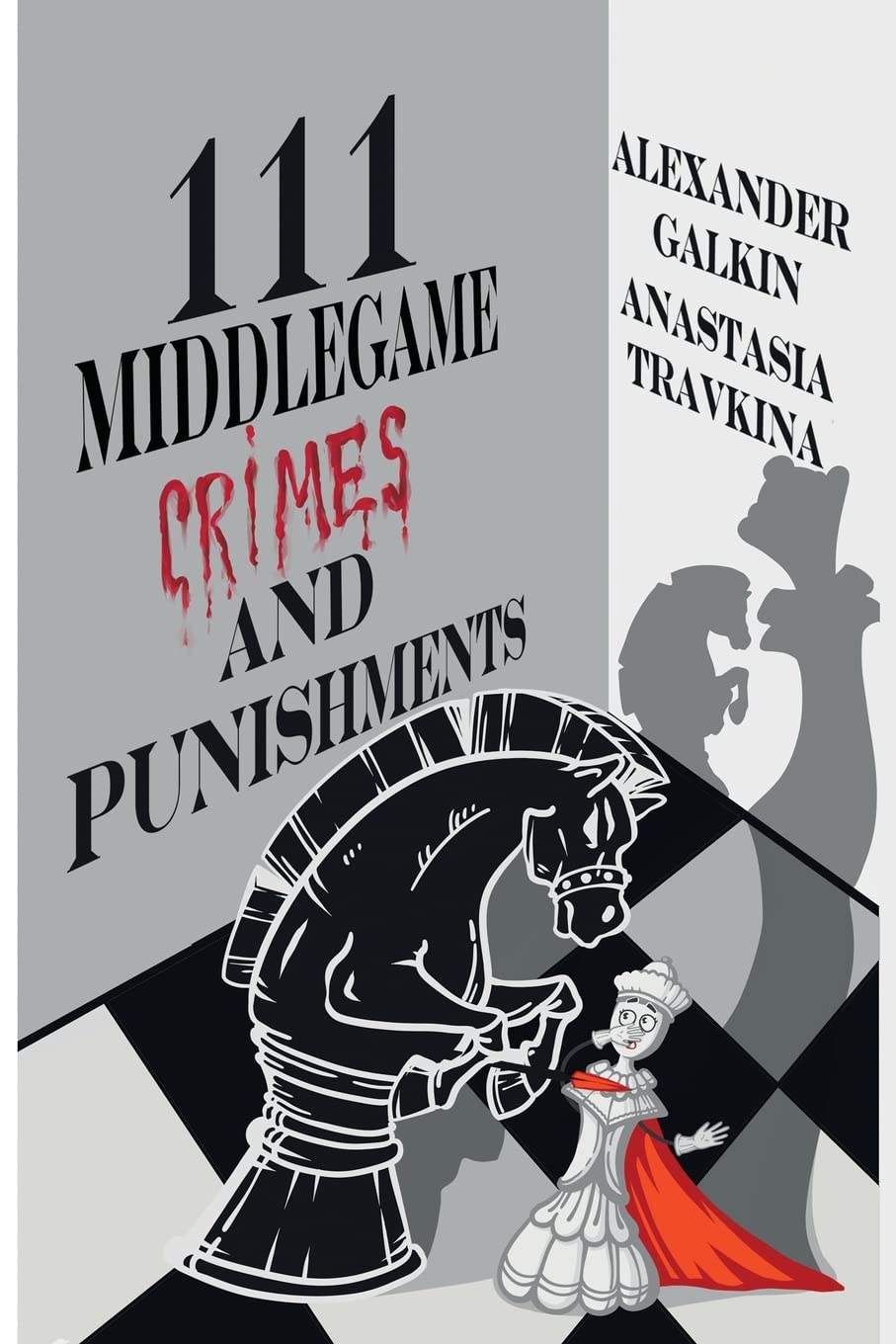
111 Middlegame crimes and punishments
Alexander Galkin
Formato papel
[Disponible]
PVP. 18,00€
Ficha técnica
- Editorial: Elk and Ruby
- Fecha de edición: 15 de Noviembre de 2021
- ISBN: 9785604177099
- Fecha de edición: 2021
- Peso: 600gr
- Dimensiones:
235 mm x 155 mm
- Nº páginas: 216
- Materias: Libros / Finales / Medios /
Compartir en:



Libro en inglés
La mayoría de las partidas de ajedrez se deciden en el medio juego. Por lo tanto, para lograr buenos resultados, es fundamental jugar bien en esta etapa. Este manual de medio juego, escrito por el Gran Maestro Alexander Galkin —nombrado Entrenador Infantil del Año en 2016 por la Federación Rusa de Ajedrez— y la Maestra Internacional Femenina Anastasia Travkina, aporta un gran volumen de conocimientos prácticos. La gran mayoría de los libros de texto sobre táctica y posicionamiento en el medio juego contienen una selección de posiciones y ejercicios donde se pide al alumno que encuentre una táctica, lleve a cabo un ataque contra el rey enemigo o elija el enfoque posicional correcto basado en ciertas "reglas".
Sin embargo, no se suele poner el foco en el error previo de uno de los jugadores que condujo a esa posición crítica donde la combinación, el ataque decisivo o la mejora posicional se hicieron posibles. En este libro, dirigido a jugadores de torneo fuertes (1900-2300 Elo o jóvenes en rápido progreso), los autores introducen un enfoque más amplio para desarrollar las habilidades tácticas y posicionales que necesita un ajedrecista formidable. Específicamente, presentan 111 posiciones de partidas de grandes maestros jugadas en 2019 —incluyendo a super-GMs como Magnus Carlsen, Fabiano Caruana, Ding Liren, e Ian Nepomniachtchi— en las que primero explican el error cometido al subestimar el contrajuego del rival y analizan cómo progresó la partida tras el castigo por dicho error. Después, regresan a la posición inicial para demostrar la continuación correcta o más prometedora. Por ello, el texto está estructurado de modo que cada reto contiene el diagrama inicial dos veces: antes de los movimientos reales de la partida y, en la página siguiente, antes de la solución.
Los autores han diseñado el libro para abordar errores temáticos específicos del medio juego:
Sacrificios erróneos. Creación de amenazas imaginarias o defensa imaginaria contra amenazas. "Caza" de peones (pawn-grabbing). La duda entre dar jaque o atacar material.
Evaluación incorrecta de cambios en la estructura de peones. Falta de vigilancia en la toma de decisiones. Sustituir la estrategia por la táctica y tomar decisiones posicionales equivocadas. Estudiar estos fragmentos clave ayudará al jugador a perfeccionar su enfoque. Primero, el estudiante analiza por qué un movimiento fue erróneo y qué contrajuego subestimó. Segundo, con esa respuesta, intenta encontrar la jugada superior. Si se trabaja con un entrenador, este debe mostrar primero el error y pedir al alumno que encuentre la refutación; luego, volver a la posición original para buscar la mejor continuación. En caso de estudio individual, el alumno puede cubrir el texto posterior para intentar hallar la solución por sí mismo.
Most chess games end in the middlegame. Therefore, to achieve good results, you have to play well at this stage of the game. This middlegame textbook by Grandmaster Alexander Galkin, who was named Children’s Trainer of the Year in 2016 by the Russian Chess Federation, and Woman International Master Anastasia Travkina, provides a large volume of practical knowledge. The vast majority of middlegame tactics and positional textbooks contain a selection of positions and exercises where the student is asked to find a tactic, carry out an attack against the enemy king or choose the right positional approach based on certain “rules”. However, there is not much focus on the mistake by one of the players that led to the critical position where the combination, decisive attack or positional improvement became possible. In this book, aimed at strong tournament players (1900-2300 Elo or fast improving juniors) the authors introduce a wider approach to developing middlegame tactical and positional skills that a formidable chess player needs. Specifically, they present 111 positions from games of grandmasters played in 2019, including super-GMs such as Magnus Carlsen, Fabiano Caruana, Ding Liren, Anish Giri, Ian Nepomniachtchi, Daniil Dubov, Wesley So, Hikaru Nakamura, Levon Aronian, and Wang Hao, in which they first explain the mistake made by one of the players in underestimating their opponent’s counterplay, then they analyze how the game progressed where punishment for the mistake is meted out. After that, they return to the starting position to demonstrate the correct or a more promising continuation. Therefore, the text is structured so that each challenge contains the starting diagram twice – before the moves in the actual game, and then, on the page overleaf, before the solution. There are numerous elements that a chess player should keep in mind in the middlegame and the authors have designed this book to address specific middle-game thematic mistakes: unsound sacrifices, creating imaginary threats, imaginary defense against threats, pawn-grabbing, give check or attack material – which is best?, wrong evaluation of changes to the pawn structure, lack of vigilance in decision-making, replacing strategy with tactics and taking wrong positional decisions. Studying these key fragments from grandmaster games will help a player to develop their middlegame approach. Firstly, the student analyzes why a move or series of moves by one of the players was erroneous. What counterplay by the opponent did the player making the mistake underestimate? Secondly, armed with this answer, the student can review the position to try and figure out the better move. If the student is working with a coach, then the coach should first set up the position on the board, demonstrate the erroneous move played, and ask the student to find the refutation to that bad move. After the refutation is found by the student, the coach should once again set up the critical position and ask the student to find the strongest continuation for the initial player. This may be one or more moves, depending on the position. Naturally, in the case of self-study the student can change their approach, either trying to figure out the refutation to the error by covering up the subsequent text, or simply studying the moves in the game before trying to find the better continuation, which is detailed overleaf together with the starting diagram.