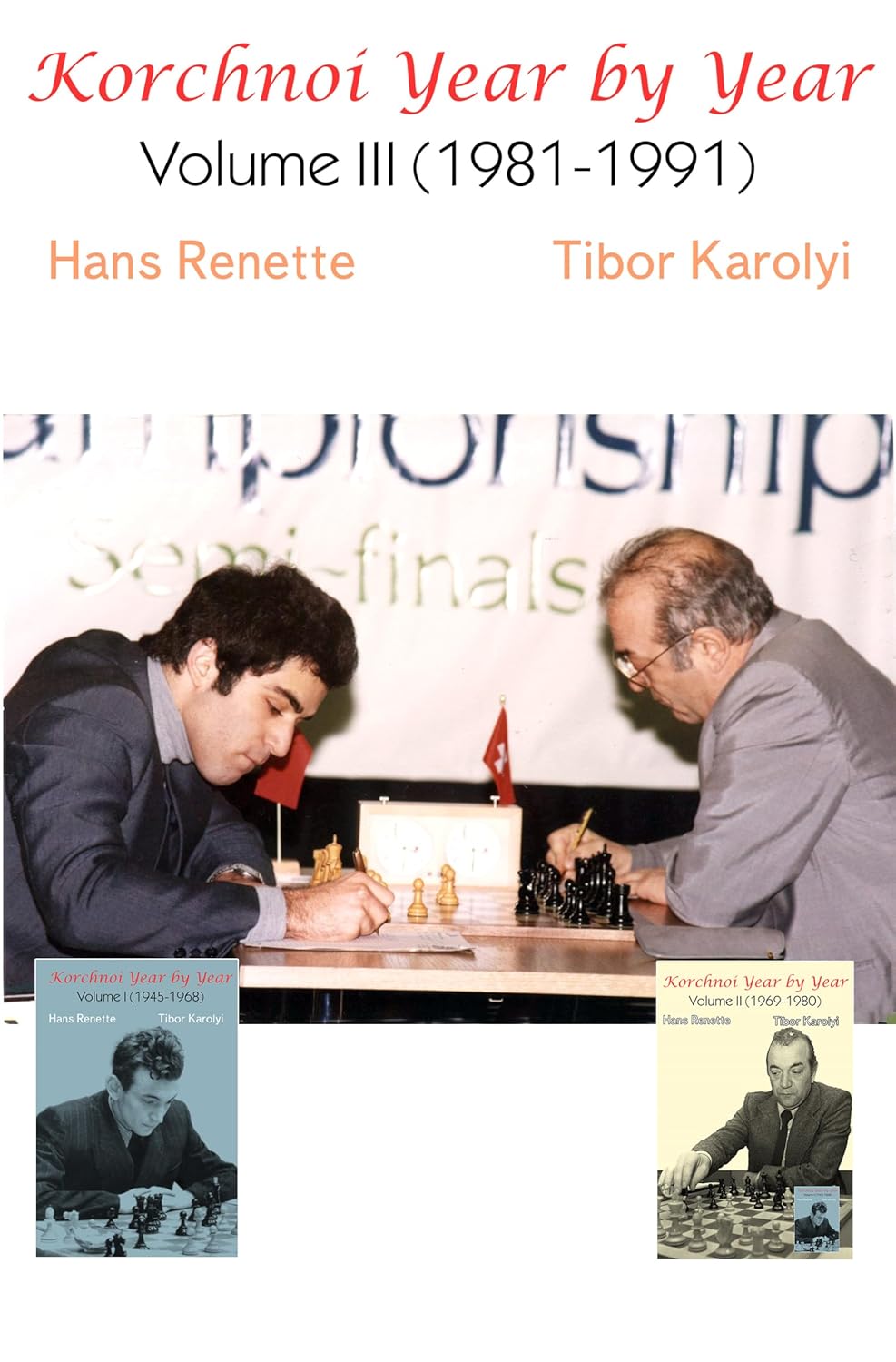
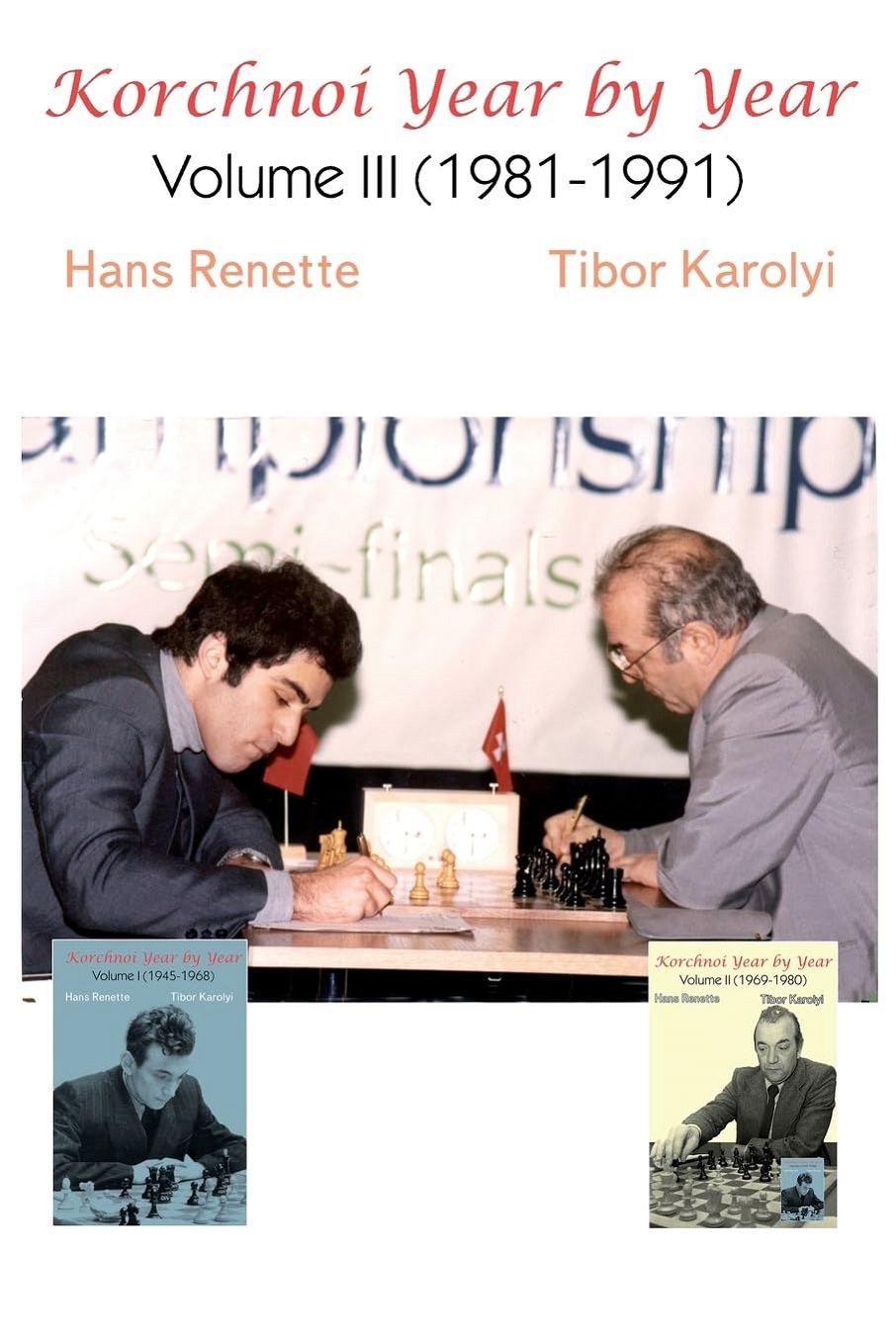
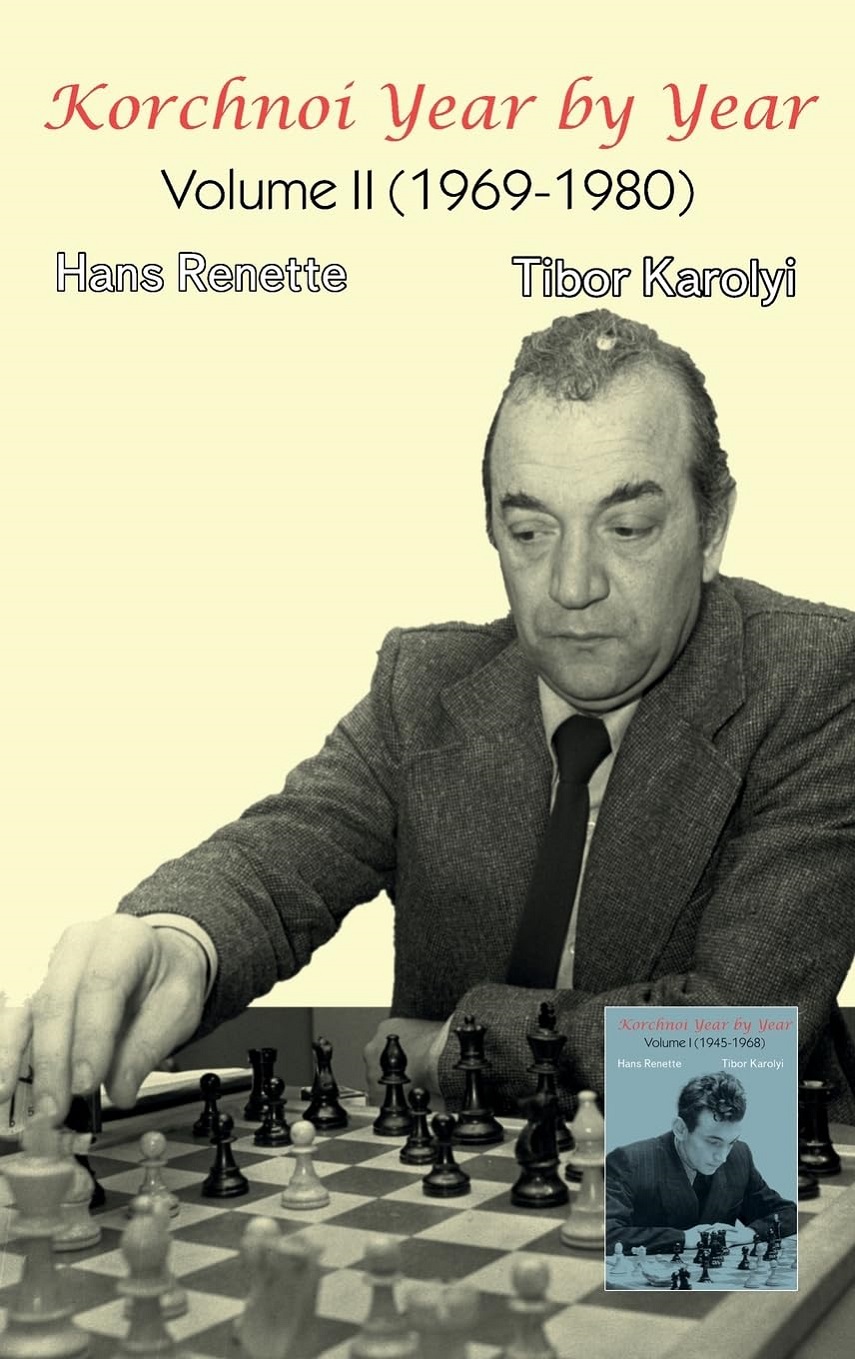
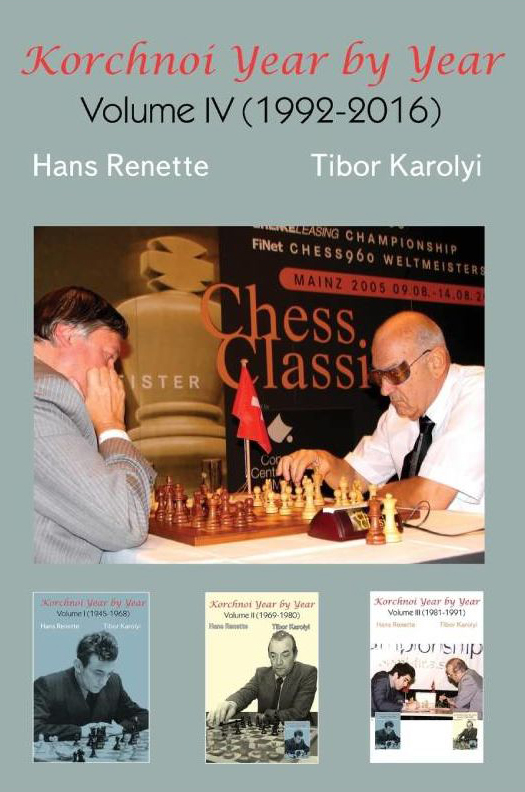
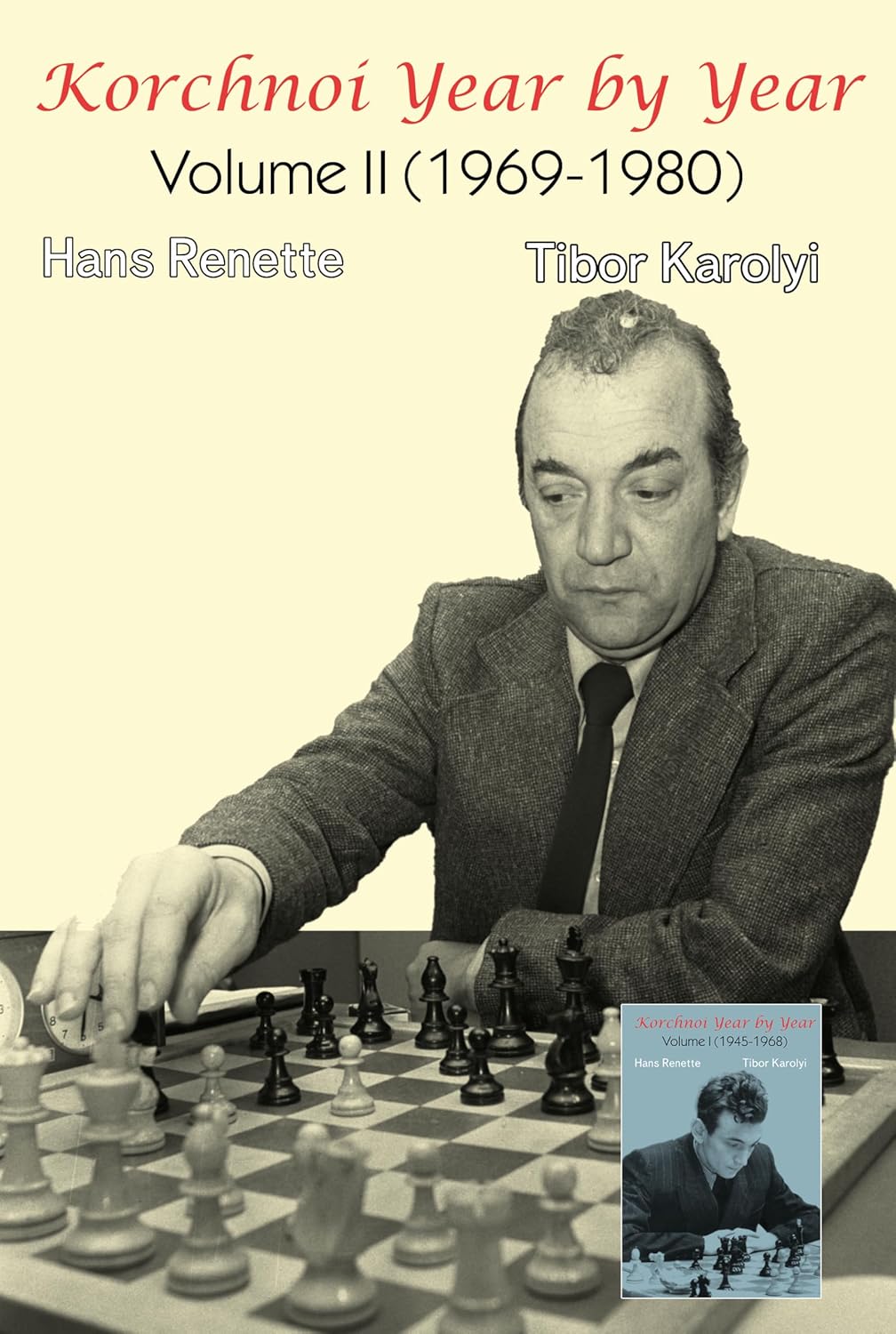
Korchnoi Volume II (1969-1980)
Hans Renette
Formato papel
[Disponible]
PVP. 42,95€
Ficha técnica
- Editorial: Elk and Ruby
- Fecha de edición: 1 de Enero de 2025
- ISBN: 9785604784952
- Fecha de edición: 2025
- Peso: 600gr
- Dimensiones:
155 mm x 235 mm
- Nº páginas: 518
- Materias: Libros / Biografías y partidas /
Compartir en:


Tienda / Libros / Biografías y partidas /
Korchnoi Volume II (1969-1980)

Libro en inglés
¡Finalista del premio al Libro del Año 2024 de la Federación Inglesa de Ajedrez! El segundo volumen del tratado de Elk and Ruby sobre Viktor Korchnoi, escrito por el MF Hans Renette y el MI Tibor Karolyi, abarca el periodo 1969-1980. Este incluye el famoso duelo por el campeonato mundial contra Karpov en Baguio en 1978, sus finales de candidatos contra Karpov en 1974 y Hübner en 1980, así como los ciclos de candidatos relacionados y sus actuaciones en los torneos más importantes. Se aporta mucho color biográfico sobre su vida y carácter, destacando en este periodo su deserción de la Unión Soviética hacia Occidente en 1976.
Al igual que en el Volumen I, se ofrece material original procedente de entrevistas con protagonistas clave y sus familiares, utilizando fuentes en ruso, alemán, holandés, húngaro e inglés para pintar el retrato más completo disponible sobre Korchnoi. En esta obra se analizan detalladamente 140 partidas y fragmentos. Además de Karpov y Hübner, entre sus oponentes figuran Fischer, Spassky, Petrosian, Smyslov, Portisch, Geller, Najdorf, Timman, Larsen, Mecking, Sosonko, Andersson, Ljubojevic, Polugaevsky, Nunn y Miles, entre otros.
El análisis revela numerosos descubrimientos nuevos. En particular, los autores identifican que Korchnoi trabajó arduamente para mejorar significativamente su habilidad en los finales durante el tiempo que fue boicoteado en los torneos por los soviéticos; algo sorprendente dado que ya superaba los cuarenta años y era el mejor jugador de su época en táctica de finales.
Además, los autores descubrieron que: Su reputación como "cazador de peones" (pawn grabber) era muy exagerada. Llevó a cabo una enorme cantidad de ataques al rey a través de la columna h. En el duelo por el título de 1978, Korchnoi estuvo a la altura de Karpov (e incluso lo superó) en las aperturas, a pesar de la preparación sin precedentes de la maquinaria ajedrecística soviética. La razón clave por la que perdió aquel encuentro fueron los apuros de tiempo. El libro se complementa con una generosa selección de fotografías, muchas de ellas procedentes del archivo familiar de Korchnoi y nunca antes publicadas.
***Short-listed for the English Chess Federation 2024 Book of the Year Prize!!*** The second volume of Elk and Ruby’s treatise on Viktor Korchnoi, penned by FM Hans Renette and IM Tibor Karolyi, covers the period 1969-1980. This encompasses Korchnoi’s famous world championship fight with Karpov at Baguio City in 1978, his candidates final matches against Karpov in 1974 and Hubner in 1980, as well as the related candidates cycles and major tournament performances. Much biographical colour is supplied on his life and character, with this period including his defection from the Soviet Union to the West in 1976. Like in Volume I, original material is provided from interviews with key protagonists and their relatives, while sources in Russian, German, Dutch and Hungarian as well as English are used to paint the most comprehensive portrait of Korchnoi available. 140 games and fragments are analysed in detail in this work. As well as Karpov and Hubner, opponents include Fischer, Spassky, Petrosian, Smyslov, Portisch, Geller, Najdorf, Timman, Larsen, Mecking, Sosonko, Andersson, Ljubojevic, Polugaevsky, Nunn, and Miles among others. Many new discoveries are made in the analysis. In particular, the authors identify that Korchnoi worked hard to improve his endgame ability significantly during the time that he was boycotted in tournaments by the Soviets, which is most surprising given that he was in his mid-forties by then, and was the best player of his time at endgame tactics. Further, the authors found that his reputation as a pawn grabber was highly exaggerated, and that he carried out a huge number of king attacks on the h-file. They also discovered that Korchnoi more than matched Karpov for openings in the 1978 title bout despite the unprecedented preparation of the Soviet chess machine, and that the key reason he lost that match was time trouble. The book is supplemented with a generous supply of photos, many taken from the Korchnoi family archive and never before published.