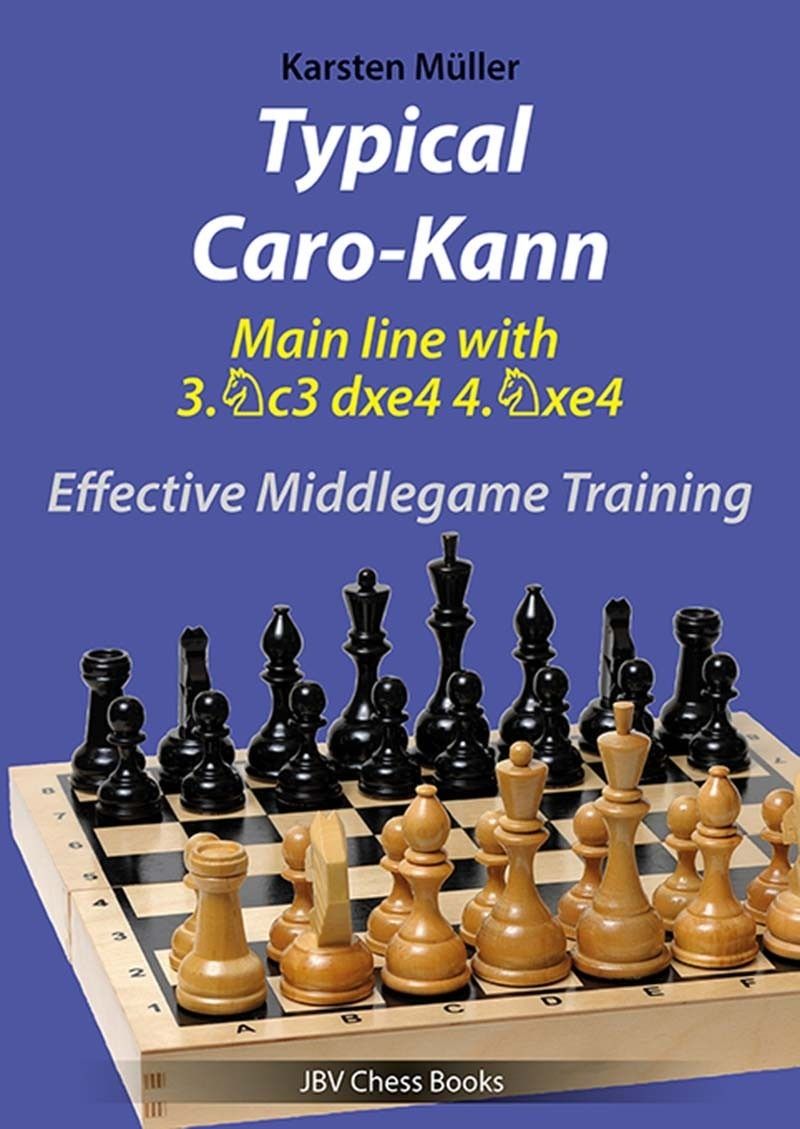
Typical Caro Kann Main line
Karsten Müller

Formato papel
[Disponible]
PVP. 21,50€
Ficha técnica
- Editorial: JBV
- Fecha de edición: 8 de Abril de 2026
- ISBN: 9783959209380
- Fecha de edición: 2026
- Peso: 400gr
- Dimensiones:
148 mm x 210 mm
- Nº páginas: 178
- Materias: Libros / Aperturas / Semiabiertas / Caro Kann /
Compartir en:


Tienda / Libros / Aperturas / Semiabiertas / Caro Kann /
Typical Caro Kann Main line

Libro en inglés
Caro-Kann típica
Al diseñar este libro, el autor se guio por las siguientes consideraciones. Si deseas aprender tal o cual apertura, puedes elegir entre decenas o incluso cientos de manuales. Pero ¿qué ocurre si lo que quieres es familiarizarte con la estrategia del medio juego en posiciones que surgen precisamente de esa apertura concreta? O, dicho de otro modo, en posiciones típicas de esa apertura. Por supuesto, en cualquier manual de medio juego aparecen aquí y allá posiciones que proceden claramente de determinadas aperturas. Sin embargo, su número es insignificante en comparación con la abundancia de ejemplos derivados de otras aperturas cuyo tratamiento estratégico no interesa en absoluto al lector. Por ejemplo —se pregunta el autor con buen criterio—, ¿no son los peones colgantes y el ataque de minorías cuestiones tan prescindibles para un jugador de 1.e4 como esenciales para uno de 1.d4? ¿Por qué debería un entusiasta de las aperturas indias preocuparse por las complejidades estratégicas de las múltiples variantes del Gambito de Dama? Y, por supuesto, a la inversa: ¿qué utilidad tienen todas esas sutilezas de las posiciones indias para un jugador que, por naturaleza, evita los esquemas con fianchetto? Precisamente este vacío tan evidente y sorprendente en la literatura sobre el medio juego fue lo que llevó al autor a intentar cubrir esa carencia: si quieres aprender la Defensa Francesa (la apertura, no el idioma), dispones de manuales y cuadernos de ejercicios en los que solo se “habla” o se juega Francesa. Este libro, sin embargo, se centra exclusivamente en la Defensa Caro-Kann; más concretamente, en la línea principal 3.Cc3 dxe4 4.Cxe4 y en las posiciones que pueden surgir de esta estructura básica, tal como se muestra detalladamente en el esquema general que sigue al prefacio. Cabe destacar especialmente que los 100 ejercicios se han organizado por temas, buscando una variedad estimulante y didáctica —por ejemplo, “el candidato al descenso”, “la única jugada”, “violencia o incremento de la presión”, entre otros.
Typical Caro-Kann
In designing this book, the author was guided by the following considerations. If you want to learn this or that opening, you can choose from dozens or even hundreds of textbooks. But what if you want to get familiar with the middlegame strategy used in positions that have emerged from exactly this or that opening? Or to put it another way: in positions that are typical for this or that opening. Of course, in every middlegame textbook there's one or the other position that clearly comes from this or that opening. However, their number is negligible in the context of example positions from all the other openings whose middlegame treatment the reader doesn't want to learn at all. For example, aren't the issues of hanging pawns and minority attack – the author asks with good reason – just as dispensable for an e4 player as they are essential for a d4 player? – Why should a die-hard enthusiast of Indian openings care about the strategic intricacies of positions resulting from all those complicated Queen's Gambit systems? And of course vice versa: what use are all these subtleties of Indian positions to a player who 'by nature' avoids fianchetto openings? And it's precisely this conspicuous and astounding vacuum in the area of middlegame literature that inspired the author to make an appropriate attempt at improvement: If you want to learn French (the opening, mind you, and not the language!), you will get a textbook and exercise book in which only French is 'spoken' or played. However, this book only deals with the Caro-Kann Defense – more precisely: with the main line 3.Kc3 dxe4 4.Kxe4 and those positions that can arise from this basic structure, as shown in detail in the overview following the preface. It deserves special mention that the 100 exercises have been assigned to specific topics for the benefit of entertaining diversity – for example 'the relegation candidate', 'the only move', 'violence or pressure increase' and the like.
Formato papel
[Disponible]
PVP. 21,50€
Otros libros de Karsten Müller
-
-

-

-
-

-

-
222 Celadas en las aperturas de peón de dama y de flanco
Karsten Müller
Editorial Hispano Europea, S.A.
-

-

-

-

-